The rapid advancements in artificial intelligence (AI) have converted various fields, which include software development. More Bonuses of the areas where AI has turned significant strides is at code generation. AI-driven tools and versions, like OpenAI’s Gesetz, are now able of generating code snippets, suggesting advancements, and even creating entire programs. While AI continues to evolve, evaluating its effectiveness becomes crucial. One interesting principle which has emerged throughout this context is the “Red-Green Factor. ” This content explores what the particular Red-Green Factor is, its application throughout AI code era, and how it can be used to assess typically the effectiveness of AJE models in generating code.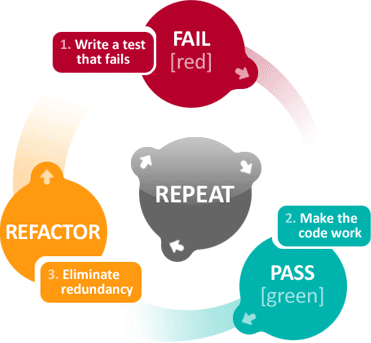
What is definitely the Red-Green Factor?
The Red-Green Element is a heuristic used to assess the quality and effectiveness of AI-generated code. It takes in inspiration from the classic “Red-Green-Refactor” cycle within test-driven development (TDD), where:
Red: Represents failing tests or code it does not fulfill the required specifications.
Green: Represents transferring tests or code that successfully meets the specifications.
Refactor: Involves improving the code while to get tests passing.
In the context of AJE code generation, the Red-Green Factor focuses on two primary elements:
Red: The level at which AI-generated program code initially fails to meet the desired specifications or contains errors.
Green: The rate at which AI-generated code successfully goes by tests or fulfills the necessary specifications.
The Red-Green Factor, as a result, helps evaluate exactly how often AI-generated program code fails (Red) compared to how often it succeeds (Green) inside meeting the specific requirements.
The Role of the Red-Green Aspect in AI Signal Generation
Quality Assessment: The Red-Green Aspect serves as the metric to gauge the quality of AI-generated code. Simply by comparing the malfunction rate (Red) with the success price (Green), developers may assess how effectively an AI unit performs in creating accurate and functional code. A high Red factor signifies a high failing rate, suggesting the AI’s code technology might be challenging. Conversely, a substantial Green factor implies a higher success rate, demonstrating the AI’s ability to make code that fulfills the requirements.
Improving AI Models: Evaluating the particular Red-Green Factor assists in identifying typically the strengths and disadvantages of AI types. If an AI model has some sort of high Red component, developers can use this information in order to refine the model’s training data, adjust its algorithms, or even implement additional quality checks. By consistently monitoring and enhancing the Red-Green Element, developers can improve the effectiveness of AJE models in computer code generation.
Benchmarking AI Performance: The Red-Green Factor can always be used like a benchmarking tool to compare different AI models. By applying the identical set of coding duties to multiple AI models and calculating their Red-Green factors, developers can identify which models perform better in producing accurate and reliable code. This comparability may help in picking the most efficient AI device for specific coding needs.
How to be able to Measure the Red-Green Factor
Measuring the Red-Green Factor consists of several steps:
Establish Specifications: Clearly specify the requirements plus specifications for the particular code that the AI is likely to create. These specifications ought to be precise in addition to unambiguous to make sure accurate evaluation.
Create Code: Use typically the AI model to be able to generate code using the defined specifications. Make certain that the generated code is tested contrary to the specifications to figure out its success or failure.
Evaluate Code: Test out the generated program code to verify if it satisfies the required specifications. Document the final results, noting regardless of whether the code moves (Green) or fails (Red) the assessments.
Calculate Red-Green Aspect: Calculate the Red-Green Factor making use of the subsequent formula:
Red-Green Factor
=
Number of Failed Tests (Red)
Total Number of Tests
Red-Green Factor=
Total Number of Tests
Number of Failed Tests (Red)
A lower Red-Green Factor indicates an increased success rate, while a greater Red-Green Element suggests a better failure rate.
Analyze Results: Analyze the particular results to realize the performance regarding the AI model. If the Red-Green Factor is high, investigate the causes behind the failures and take further actions to boost the model.
Circumstance Studies: Applying the particular Red-Green Factor
OpenAI Codex: OpenAI Questionnaire, an advanced AI model for signal generation, can be evaluated using the particular Red-Green Factor. By testing Codex on various coding tasks and measuring their failure and success rates, developers may gain insights into their effectiveness and locations for improvement.
GitHub Copilot: GitHub Copilot, another popular AI code generation device, can also become assessed while using Red-Green Factor. By evaluating its performance together with other AI designs and analyzing the Red-Green Factor, designers can determine precisely how well Copilot works in generating exact and functional code.
Challenges and Restrictions
Defining Specifications: One particular challenge in using the Red-Green Factor is defining clear and precise specifications. Ambiguous or badly defined requirements may lead to erroneous evaluations of the AI-generated code.
Intricacy of Code: Typically the Red-Green Factor may possibly not fully capture the complexity of code generation jobs. Some coding responsibilities may be inherently more challenging, leading to higher malfunction rates even with some sort of high-performing AI design.
Dynamic Nature regarding AI Models: AI models are continually evolving, and the efficiency may vary over time. Continuous monitoring plus updating of the Red-Green Factor are usually necessary to maintain rate with these adjustments.
Future Directions
Processing of Metrics: The particular Red-Green Factor is a valuable tool, yet there is prospective for refining plus expanding it to capture additional areas of code quality, for instance code efficiency, readability, and maintainability.
Integration with Development Equipment: Integrating the Red-Green Factor with enhancement tools and environments can provide current feedback and help developers quickly identify and address concerns with AI-generated program code.
Benchmarking and Standardization: Establishing standard standards and practices intended for measuring the Red-Green Factor can improve its effectiveness and facilitate meaningful comparisons between different AJE models.
Conclusion
The Red-Green Factor gives a useful framework regarding evaluating the efficiency of AI throughout code generation. Simply by measuring the disappointment and success of AI-generated code, designers can measure the quality of AI types, identify areas for improvement, and make well informed decisions in regards to the finest tools for his or her code needs. As AI continues to enhance, the Red-Green Aspect will play a crucial role inside ensuring that AI-generated code meets the greatest standards of accuracy and reliability
Evaluating the Effectiveness associated with the Red-Green Factor in AI Program code Generation
by
Tags:
Leave a Reply